9 Fresh Flower Decoration Ideas For Every Room In Your Home
A 2026 survey of interior design professionals found that homes featuring fresh flowers consistently score higher on perceived warmth, creativity, and overall livability than those without any botanical elements. That single finding reframes flowers from a luxury indulgence into a practical design tool. Whether you have a sprawling open-plan kitchen or a compact studio apartment, the 9 fresh flower decoration ideas for every room in your home covered in this guide will help you use blooms with intention, confidence, and style.
Disclosure: This post contains affiliate links. As an Amazon Associate, we earn from qualifying purchases, and at no extra cost to you.

Fresh flowers do more than look beautiful. Research consistently links natural elements indoors to reduced stress, improved mood, and even sharper focus. Yet most people default to one vase of mixed stems on the dining table and call it done. This article goes further, offering room-by-room strategies that draw on the boldest floral design trends shaping interiors in 2026 [2][6].
Key Takeaways
- Matching flower scale, color, and arrangement style to each room’s function dramatically improves the overall impact of fresh flower decoration.
- Layered floral interiors that mix sizes, textures, and botanical accents create depth and visual interest in living rooms and open-plan spaces [1].
- Monochrome and mono-floral arrangements deliver sophisticated minimalism in entryways and home offices without visual clutter [3].
- Sculptural and architectural flower installations are replacing traditional centerpieces in dining rooms and stairwells for 2026 [10].
- Farm-to-vase, locally sourced, and seasonal blooms are the most sustainable and cost-effective choice for kitchens and family rooms [5].
Why Room-Specific Flower Decoration Matters
Most decorating guides treat flowers as an afterthought, a finishing touch rather than a structural element of a room’s design. That approach wastes the full potential of fresh blooms. Each room in your home has a different function, different light conditions, different furniture scale, and a different emotional register. A dramatic sculptural installation that looks stunning in a double-height dining room would feel oppressive in a small bathroom. A delicate single stem that reads as refined on a minimalist desk would disappear entirely on a large kitchen island.
The 9 fresh flower decoration ideas for every room in your home explored below treat each space as its own design brief. The goal is not to fill every surface with flowers but to place the right bloom, in the right vessel, at the right scale, in the right room. When those four variables align, fresh flower decoration stops being decoration and starts being architecture.
Floral designers in 2026 are increasingly talking about flowers as “living materials” rather than accessories [7]. That shift in language reflects a deeper shift in thinking: flowers are now being chosen with the same care as upholstery fabrics or wall paint. The ideas below reflect that professional-grade approach, translated into practical steps any homeowner can follow.
The 9 Fresh Flower Decoration Ideas For Every Room In Your Home
1. Layer Scales and Textures in the Living Room

The living room is the most complex room to decorate with flowers because it contains the most visual information. Sofas, cushions, rugs, artwork, and shelving all compete for attention. The answer is not one large arrangement but a layered approach that distributes botanical interest across multiple heights and surfaces.
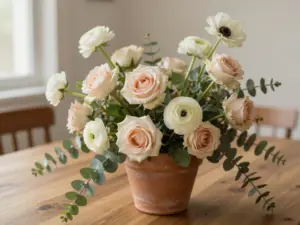
Start with a statement vase on the coffee table, something with presence, like a cluster of garden roses mixed with eucalyptus and trailing jasmine. Then add a smaller, simpler arrangement on a side table or bookshelf. Finally, introduce a botanical accent at floor level: a large potted tropical leaf plant, a sculptural dried pampas grass arrangement, or a low ceramic dish of floating flower heads.
This layering principle, large, medium, small, mirrors how professional interior stylists build visual depth [1]. The key is to keep the color palette cohesive across all three layers. If your statement vase uses blush pinks and dusty greens, carry at least one of those tones into each smaller accent. Mixing floral patterns on cushions or wallpaper with real flowers is also back in fashion for 2026, with designers deliberately blurring the line between printed botanicals and living ones [1].
Pro tip: Odd numbers of stems always look more natural than even numbers. Use three, five, or seven stems per arrangement rather than four or six.
2. Use a Monochrome Arrangement in the Entryway

The entryway is the first impression your home makes, and it sets the emotional tone for everything that follows. Clutter reads as chaos; restraint reads as confidence. A monochrome flower arrangement, all white, all cream, or all deep burgundy, delivers immediate sophistication without competing with coats, bags, and shoes that inevitably occupy the same space.
Monochrome does not mean monotone. A single-color arrangement can include extraordinary textural variety: smooth ranunculus petals alongside spiky alliums, waxy gardenias beside feathery astilbe. The visual interest comes entirely from texture and form rather than color contrast [3].
For 2026, floral designers are favoring what they call “mono-floral” arrangements, one flower variety, massed together in a single vessel, as the ultimate expression of confident minimalism [4]. A tight cluster of white anemones in a slender black ceramic vase on an entryway console is both striking and effortless to maintain.
Best flowers for monochrome entryway arrangements:
| Color Palette | Flower Choices | Vessel Style |
|---|---|---|
| All white | Anemone, gardenia, ranunculus | Black ceramic or dark glass |
| All cream | Lisianthus, garden rose, freesia | Natural linen-wrapped vase |
| All burgundy | Dahlia, scabiosa, chocolate cosmos | Brass or aged copper |
| All green | Bells of Ireland, viburnum, hellebore | Clear glass or white porcelain |
3. Build a Sculptural Centerpiece for the Dining Room

The dining table is the most ceremonial surface in the home. It hosts celebrations, family dinners, and the daily ritual of gathering together. A sculptural flower installation, one that prioritizes form and architecture over conventional prettiness, elevates that ceremony without requiring a florist’s training.
Sculptural arrangements for 2026 favor flowers with strong geometric shapes: protea, king protea, anthurium, bird of paradise, and dried lotus pods [10]. These blooms hold their structure over several days and create genuine visual drama. Combine them with tall, branching elements like flowering quince or magnolia branches to add vertical height that draws the eye upward.
The critical rule for dining table arrangements is height management. An arrangement that blocks sightlines across the table kills conversation. Either go very low, a wide, shallow arrangement that sits below eye level, or go very tall and narrow, using a slender column vase that allows guests to see each other underneath the canopy of blooms.
“Sculptural flora and earth tones are converging as the dominant aesthetic in 2026 home design, replacing the soft, romantic arrangements that defined the previous decade.” [10]
For a dinner party, consider placing three smaller sculptural arrangements in a line down the center of the table rather than one large centerpiece. This creates a more dynamic, gallery-like effect and allows for easier conversation.
4. Bring Farm-to-Vase Blooms Into the Kitchen

The kitchen is the most informal room in the house, and its flower decoration should reflect that. Stiff, formal arrangements feel out of place next to a cutting board and a bowl of fruit. What works instead is the farm-to-vase aesthetic: loose, imperfect, seasonal bunches that look as though they were cut from a garden that morning.
Farm-to-vase means prioritizing locally grown, seasonally available flowers over imported, year-round varieties [5]. In practical terms, this means visiting a farmers market rather than a supermarket for your kitchen blooms. Sunflowers in late summer, dahlias in autumn, tulips in spring, and ranunculus in winter are all examples of flowers that are abundant, affordable, and deeply connected to their season.
The vessels matter enormously in a kitchen setting. Mason jars, ceramic pitchers, old wine bottles, and terracotta pots all reinforce the casual, honest quality of farm-fresh flowers. Avoid crystal or formal silver vessels, they create a tonal mismatch that makes both the vessel and the flowers look wrong.
Seasonal kitchen flower guide:
- Spring: Tulips, daffodils, sweet peas, ranunculus
- Summer: Sunflowers, zinnias, dahlias, cosmos
- Autumn: Chrysanthemums, marigolds, dried grasses, rosehips
- Winter: Amaryllis, paperwhites, hellebores, evergreen branches
5. Create a Calming Bedside Arrangement for the Bedroom

The bedroom is a sanctuary, and its flower decoration should serve the room’s primary purpose: rest and restoration. Strong fragrances, bold colors, and complex arrangements all work against that goal. What works is simplicity, softness, and scent that is present but not overpowering.
A single stem or a small, loose posy of three to five flowers on the bedside table is almost always the right choice. Lavender, sweet peas, garden roses, and peonies all offer gentle fragrance without being aggressive. Soft colors, blush, lilac, pale peach, dusty mauve, reinforce the calming atmosphere.
One detail that is easy to overlook: the height of a bedside arrangement matters. When you are lying down, your eye level drops significantly. An arrangement that looks balanced when you are standing will look entirely different from a pillow. Test your arrangement from a lying position before settling on the final height.
For 2026, bedroom floral styling is moving toward what designers describe as “quiet luxury botanicals”, arrangements that feel expensive and considered without being showy [8]. A single stem of a garden rose in a small hand-thrown ceramic bud vase achieves this perfectly.
6. Style a Minimalist Arrangement for the Home Office

Concentration is the home office’s most valuable resource, and the wrong decoration actively depletes it. Busy, colorful, or fragrant arrangements create visual and sensory noise that competes with focused work. The solution is a mono-floral arrangement in a neutral or muted palette, placed at the periphery of your sightline rather than directly in front of you.
A single white orchid in a sleek white pot is the classic choice for a reason: it is visually quiet, long-lasting, and requires almost no maintenance. For those who find orchids too corporate, a small arrangement of dried botanicals, preserved eucalyptus, dried strawflowers, or bleached lunaria, offers similar visual restraint with zero maintenance and indefinite longevity [3].
The home office is also the room where the vessel can do the most design work. A beautifully crafted ceramic or hand-blown glass vase with a single stem makes a stronger design statement than a cluttered mixed arrangement. The flower becomes a focal point rather than a distraction.
Best home office flower choices:
- Single white phalaenopsis orchid in a white ceramic pot
- Dried eucalyptus stem in a narrow brass bud vase
- Small cluster of white ranunculus in a clear glass vessel
- Single stem of green viburnum in a dark ceramic vase
- Preserved moss arrangement in a shallow wooden tray
7. Use Cascading Greenery and Blooms in the Stairwell

The stairwell is one of the most underused decorating opportunities in the home. Its vertical movement and transitional nature make it ideal for cascading, architectural floral installations that would overwhelm a static room. In 2026, floral designers are treating stairwells as gallery spaces, using newel posts, bannisters, and wall-mounted vessels to create installations that unfold as you move through the space [10].
A practical starting point is to attach small bud vases or test tube vases to the bannister at irregular intervals, each containing a single stem or small cluster of flowers. As you move up the stairs, the arrangement reveals itself progressively. This creates a sense of discovery and makes the stairwell feel like a designed space rather than a utilitarian corridor.
For grander installations, trailing greenery, smilax, ivy, jasmine vine, or eucalyptus garlands, can be woven along the bannister and punctuated with larger flower heads at intervals. This approach works particularly well for celebrations and events but can also be maintained as a permanent feature with regular refreshing.
“Architectural floral installations in transitional spaces like stairwells and hallways are one of the defining interior trends of 2026, transforming functional corridors into immersive botanical experiences.” [6]
8. Float Flowers in the Bathroom

The bathroom is the room most people forget when thinking about fresh flower decoration, yet it is also the room where a single well-chosen bloom has the most transformative effect. The scale is intimate, the surfaces are hard and reflective, and the atmosphere is already sensory. One beautiful flower completes that sensory experience in a way that no candle or diffuser can replicate.
Floating flowers, single blooms or petals placed in a shallow bowl of water, are the most elegant and practical choice for a bathroom. A wide, low ceramic bowl filled with water and three floating gardenia heads, or a handful of rose petals, creates an immediate spa-like atmosphere. The water keeps the blooms fresh longer than they would last in a vase, and the reflection adds visual depth.
For bathrooms with a windowsill, a small potted orchid or a single stem in a bud vase works beautifully. The humidity of the bathroom actually benefits many tropical flowers, extending their vase life compared to drier rooms. Anthuriums, orchids, and tropical heliconias all thrive in bathroom conditions.
Bathroom flower styling tips:
- Use white or cream flowers to enhance the clean, spa-like aesthetic
- Place arrangements near mirrors to double their visual impact through reflection
- Choose flowers with subtle rather than strong fragrance to avoid overpowering the space
- Replace water in floating arrangements every two days to keep it clear
9. Energize the Children’s Room or Playroom With Cheerful Seasonal Blooms

Children’s rooms present a unique decorating challenge: the space needs to be stimulating and joyful without becoming chaotic, and any decoration must be safe and non-toxic. Fresh flowers, chosen thoughtfully, can introduce color, natural curiosity, and a gentle lesson in caring for living things.
Sunflowers, daisies, gerberas, and zinnias are ideal for children’s spaces. They are bold, cheerful, visually simple, and non-toxic. Their large, clear forms are also easier for children to identify and engage with than complex, layered arrangements. A single large sunflower in a brightly colored ceramic pot on a high shelf, out of reach but clearly visible, adds a burst of warmth without creating a safety concern.
For older children, involving them in choosing and arranging their own flowers is a genuinely enriching activity. Research consistently shows that children who engage with plants and flowers develop stronger observational skills and a greater sense of responsibility [5]. A small vase that a child fills themselves, even imperfectly, is worth more than a perfectly styled arrangement placed by an adult.
Seasonal flowers are particularly valuable in children’s rooms because they create a natural rhythm of change that helps children connect to the passing of time and the cycle of seasons.
How to Make Fresh Flowers Last Longer in Every Room
Knowing which flowers to use in each room is only half the equation. Keeping them fresh long enough to enjoy requires a few consistent habits.
The five rules of fresh flower longevity:
- Always cut stems at a 45-degree angle under running water before placing them in a vase.
- Remove any leaves that will sit below the waterline to prevent bacterial growth.
- Change the water every two days and re-cut stems by half a centimeter each time.
- Keep arrangements away from direct sunlight, heating vents, and ripening fruit, all of which accelerate wilting.
- Use a commercial flower food sachet or a homemade solution of one teaspoon of sugar and two drops of bleach per liter of water.
Different rooms present different challenges for flower longevity. Kitchens are warm and often humid, which accelerates wilting, choose hardy varieties like chrysanthemums or alstroemerias for kitchen arrangements. Bedrooms are cooler and drier, which suits more delicate flowers like sweet peas and garden roses. Bathrooms have high humidity but often low light, which suits tropical varieties like orchids and anthuriums.
Matching Flowers to Your Interior Design Style
Not every flower works in every interior. A loose, garden-style arrangement of sweet peas and foxgloves looks perfect in a country cottage but jarring in a sleek, minimalist apartment. Matching your flower choices to your existing interior style creates coherence rather than contrast.
| Interior Style | Recommended Flowers | Vessel Style |
|---|---|---|
| Minimalist/Scandinavian | Single stems, dried botanicals, white orchids | Slender ceramic, clear glass |
| Maximalist/Eclectic | Mixed garden blooms, tropical leaves, bold colors | Vintage ceramic, patterned pottery |
| Industrial/Urban | Architectural flowers, dried grasses, dark foliage | Concrete, dark metal, raw wood |
| Traditional/Classic | Garden roses, peonies, lilac, hydrangea | Crystal, silver, formal porcelain |
| Coastal/Natural | Wildflowers, sea lavender, grasses, succulents | Driftwood, wicker, bleached terracotta |
The 2026 trend reports consistently emphasize that the most successful floral interiors are those where the flowers feel like a natural extension of the existing design language rather than a separate decorative layer [2][9]. When in doubt, pick up a color from your existing palette and build the arrangement around that single reference point.
Conclusion
The 9 fresh flower decoration ideas for every room in your home explored in this guide share a common principle: intentionality. The most beautiful floral interiors are not the ones with the most flowers or the most expensive blooms. They are the ones where every arrangement has been chosen with a clear understanding of the room’s function, scale, light, and emotional register.
Start with one room. Choose the space where you spend the most time and where a fresh arrangement would bring you the most daily pleasure. Apply the principles from the relevant section above: the right flower, the right vessel, the right scale, the right position. Live with it for a week and notice how it changes the feel of the room.
Then move to the next room. Over time, you will develop an instinctive sense of what works in each space, and fresh flower decoration will become as natural and habitual as making the bed or lighting a candle. The investment is modest. The return, in beauty, mood, and the simple pleasure of living with living things, is considerable.
Your actionable next steps:
- Walk through your home today and identify the one room that would benefit most from a fresh flower arrangement.
- Choose a flower variety that is currently in season in your region and available at a local farmers market or independent florist.
- Select a vessel from your existing collection that matches the scale and style of the room.
- Place the arrangement, step back, and assess it from the perspective of someone entering the room for the first time.
- Commit to refreshing that one arrangement weekly for one month before expanding to other rooms.
References
[1] Floral Interiors Trends – https://us.pigletinbed.com/blogs/the-piglet-journal/floral-interiors-trends
[2] Expert Florists Reveal Top Blooming Trends To Harmonize Homes In 2026 – https://petalsartistry.com/expert-florists-reveal-top-blooming-trends-to-harmonize-homes-in-2026/
[3] Floral Trends 2026 A Comprehensive Look At What S Transforming Modern Floristry – https://alys-studio.ae/ar/blogs/news/floral-trends-2026-a-comprehensive-look-at-what-s-transforming-modern-floristry
[4] The Flower Forecast 2026 Shapes Textures And Styles To Watch – https://www.arugulatango.com/blog/the-flower-forecast-2026-shapes-textures-and-styles-to-watch
[5] 5 Major 2026 Floral Trends – https://monsoonflowers.com/blogs/topics/5-major-2026-floral-trends
[6] Floral Trends Forecast 2026 A Year Of Fearless Design – https://floristsreview.com/floral-trends-forecast-2026-a-year-of-fearless-design/
[7] Floristry Forecast 2026 The Future Of Botanical Styling In Interiors And Retail – https://www.floralsilk.co.uk/trade/trade-blog/Floristry-Forecast-2026-The-Future-of-Botanical-Styling-in-Interiors-and-Retail/
[8] Major Floral Trends For 2026 – https://thewed.com/magazine/major-floral-trends-for-2026
[9] Floral Inspirations 2026 – https://www.etherealcreators.com/blog/floral-inspirations-2026
[10] Sculptural Flora Earth Tones Define Converging 2026 Home Design Trends – https://miladflower.com/sculptural-flora-earth-tones-define-converging-2026-home-design-trends/