9 Vibrant Construction Paper Flowers Kids Can Make
A single sheet of construction paper costs less than a penny, yet research from early childhood education programs consistently shows that hands-on paper crafting builds fine motor skills, spatial reasoning, and creative confidence in children as young as three. That is a remarkable return on a nearly zero investment. If you are looking for a structured, engaging activity that keeps kids busy while genuinely developing their abilities, the 9 vibrant construction paper flowers kids can make listed in this guide deliver exactly that.
Disclosure: This post contains affiliate links. As an Amazon Associate, we earn from qualifying purchases, and at no extra cost to you.
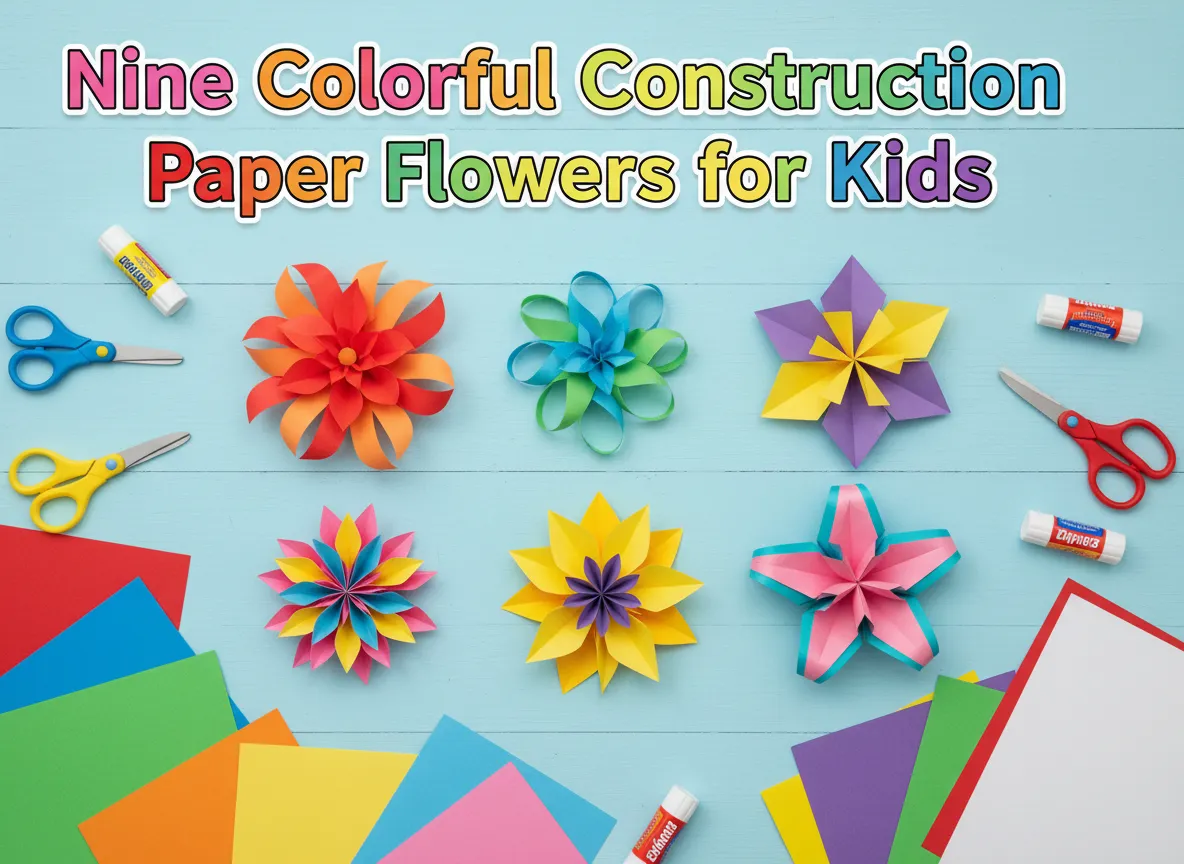
I have spent years working with kids in classroom and home settings, and paper flower crafts are among the most reliable activities I return to again and again. They are forgiving for beginners, endlessly customizable for experienced crafters, and they produce something beautiful enough to display, gift, or use as a learning tool.
Key Takeaways
- All nine flower projects use inexpensive, widely available materials, primarily construction paper, scissors, and glue.
- Each project targets a specific developmental benefit, from fine motor skills to math concepts like fractions and geometry.
- Most projects can be completed in 20 to 45 minutes, making them ideal for after-school sessions or weekend activities.
- Several designs double as educational tools, connecting art to subjects like math, science, and spatial reasoning.
- Every project is scalable in difficulty, so younger children can participate with adult guidance while older kids can work independently.
Why Construction Paper Flowers Are the Perfect Kids Craft
Before diving into the full list of 9 vibrant construction paper flowers kids can make, it helps to understand why this specific craft category punches so far above its weight.
Construction paper is forgiving. Unlike fabric or wood, it can be cut, torn, folded, and glued without special tools or safety concerns. A child who makes a mistake can simply start over with another sheet.
The sensory experience is rich. The texture, the sound of tearing, the smell of glue, and the visual pop of bright colors all engage multiple senses at once. Occupational therapists frequently recommend paper crafts for children working on hand strength and coordination.
Flowers are universally motivating. In my experience, both boys and girls respond positively to flower crafts because the end result is immediately recognizable and praise-worthy. A child who finishes a paper flower has made something that looks like something, which builds confidence fast.
The educational connections are deep. As you will see in the list below, paper flower projects can teach geometry, fractions, symmetry, and even basic engineering concepts, all while the child thinks they are just making something pretty.
What You Need to Get Started
Most of these projects share a common supply list. Gather these basics before you begin:
- Construction paper in multiple colors (at minimum: red, yellow, orange, pink, green, purple, blue)
- Child-safe scissors
- White school glue or a glue stick
- A pencil for tracing
- Popsicle sticks or green pipe cleaners for stems
- A ruler for projects requiring measured strips
Optional but useful: a hole punch, watercolor paints for accent details, and clear contact paper for the suncatcher projects.
The Complete List of 9 Vibrant Construction Paper Flowers Kids Can Make
The projects below are ordered from simplest to most complex. Each entry includes the target age range, the primary developmental benefit, and a step-by-step overview so you can guide kids through the process confidently.
1. Mother’s Day Bouquet Flowers
Best age: 4 and up
Time: About 20 minutes
Primary benefit: Fine motor skills, gift-giving culture
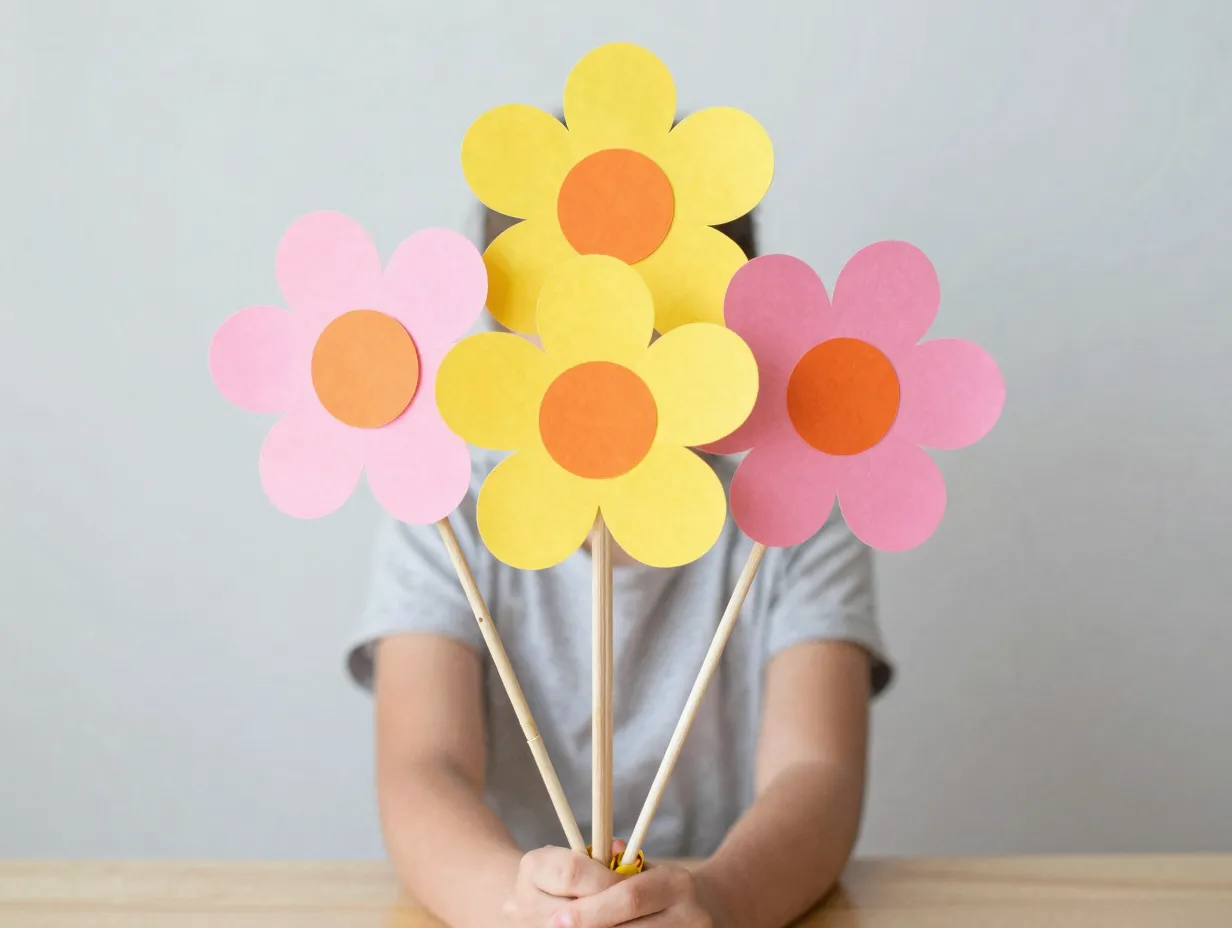
This is the project I recommend most often to parents looking for a quick win. Kids cut simple petal shapes from brightly colored construction paper, layer them around a circular center, and glue the finished flower onto a popsicle stick. Multiple flowers are then bundled together to form a bouquet [1].
Steps at a glance:
- Cut five to six teardrop shapes from one color of paper for petals.
- Cut a small circle from a contrasting color for the center.
- Arrange the petals in a ring and glue the center on top.
- Glue the flower base onto a popsicle stick.
- Repeat to make several flowers, then tie or tape them into a bouquet.
The finished bouquet makes an excellent gift for Mother’s Day, Teacher Appreciation Week, or any occasion. The 20-minute completion time means even young children stay engaged from start to finish [1].
“The best crafts are the ones where the child is proud enough to hand it to someone they love. A paper bouquet does that every time.”
2. 3D Looped Construction Paper Blooms
Best age: 6 and up
Time: 25 to 35 minutes
Primary benefit: Understanding depth and three-dimensional form
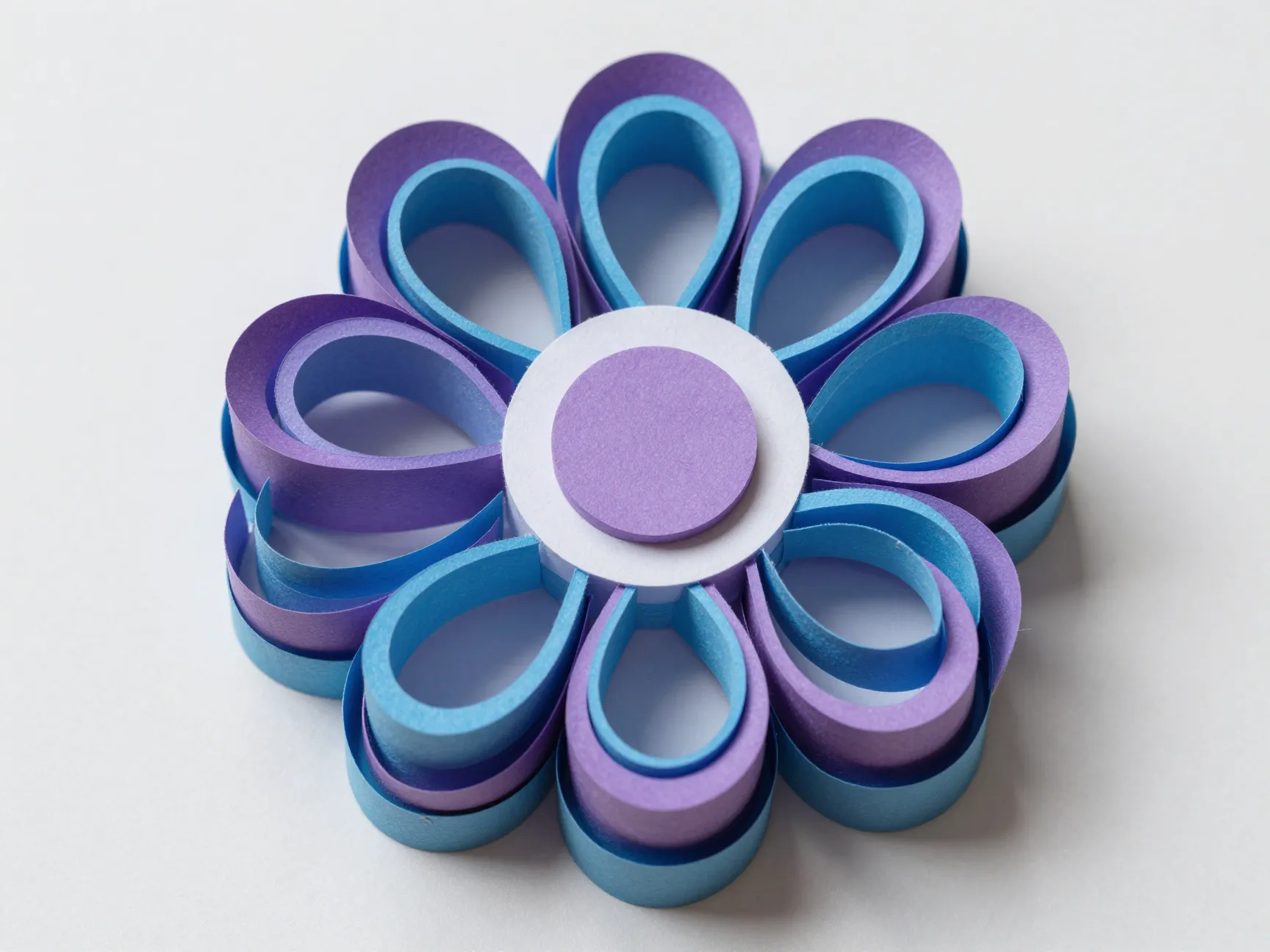
This project introduces children to the concept of three-dimensional structure using a surprisingly simple technique. Kids cut long, uniform strips of construction paper, loop each strip, and glue the ends to a central paper circle [2]. As the loops stack up around the center, a dimensional, sculptural flower emerges.
Steps at a glance:
- Cut a circle about two inches in diameter from any color of paper.
- Cut strips of paper approximately one inch wide and six inches long.
- Loop each strip and glue both ends to the edge of the circle.
- Continue adding loops in concentric rings, alternating colors if desired.
- Glue a smaller decorative circle on top of the center to finish.
This craft is a natural entry point for discussing concepts like depth and perspective. When I do this project in classroom settings, I often ask kids to compare their flat paper strip to the finished 3D bloom and describe what changed. The answers are always insightful [2].
3. Origami Tulips
Best age: 7 and up
Time: 20 to 30 minutes
Primary benefit: Spatial reasoning, following sequential instructions
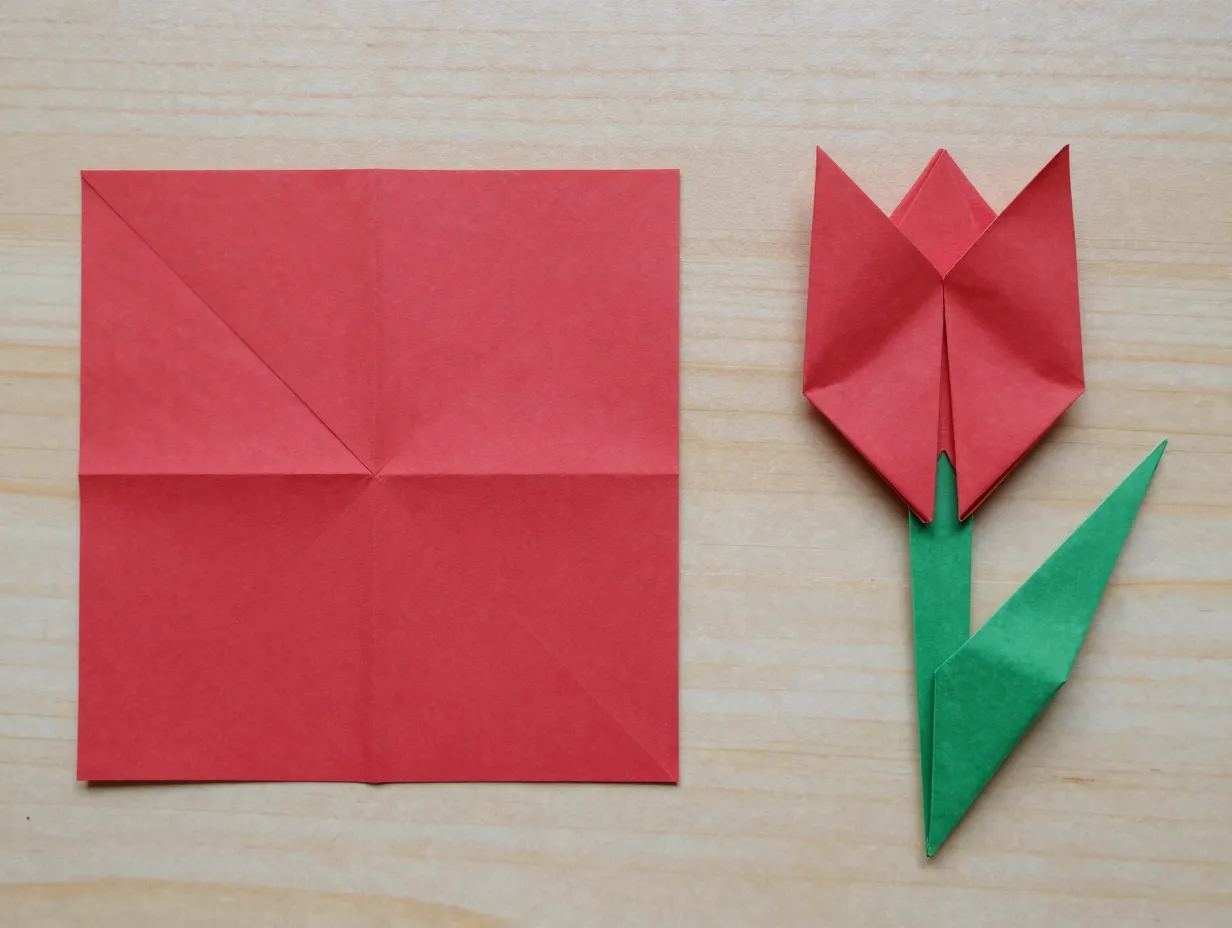
Origami is one of the oldest paper-folding traditions in the world, and the tulip is one of its most accessible forms for children. Using a single square of construction paper, kids follow a sequence of folds to produce a recognizable tulip shape [3].
Steps at a glance:
- Start with a square sheet of construction paper, colored side down.
- Fold the paper in half diagonally to form a triangle.
- Fold the left and right corners up to the top point.
- Fold the bottom corners of those flaps back down slightly to form petals.
- Gently open the base and press to shape the tulip body.
- Pair with a green paper stem folded separately.
Origami tulips are excellent for older children because they require patience and precise folding. The activity builds spatial reasoning and the ability to follow multi-step instructions, both of which are strongly linked to mathematical ability [3].
4. Whimsical Shape Flowers
Best age: 5 and up
Time: 20 to 30 minutes
Primary benefit: Creativity, free-form artistic expression
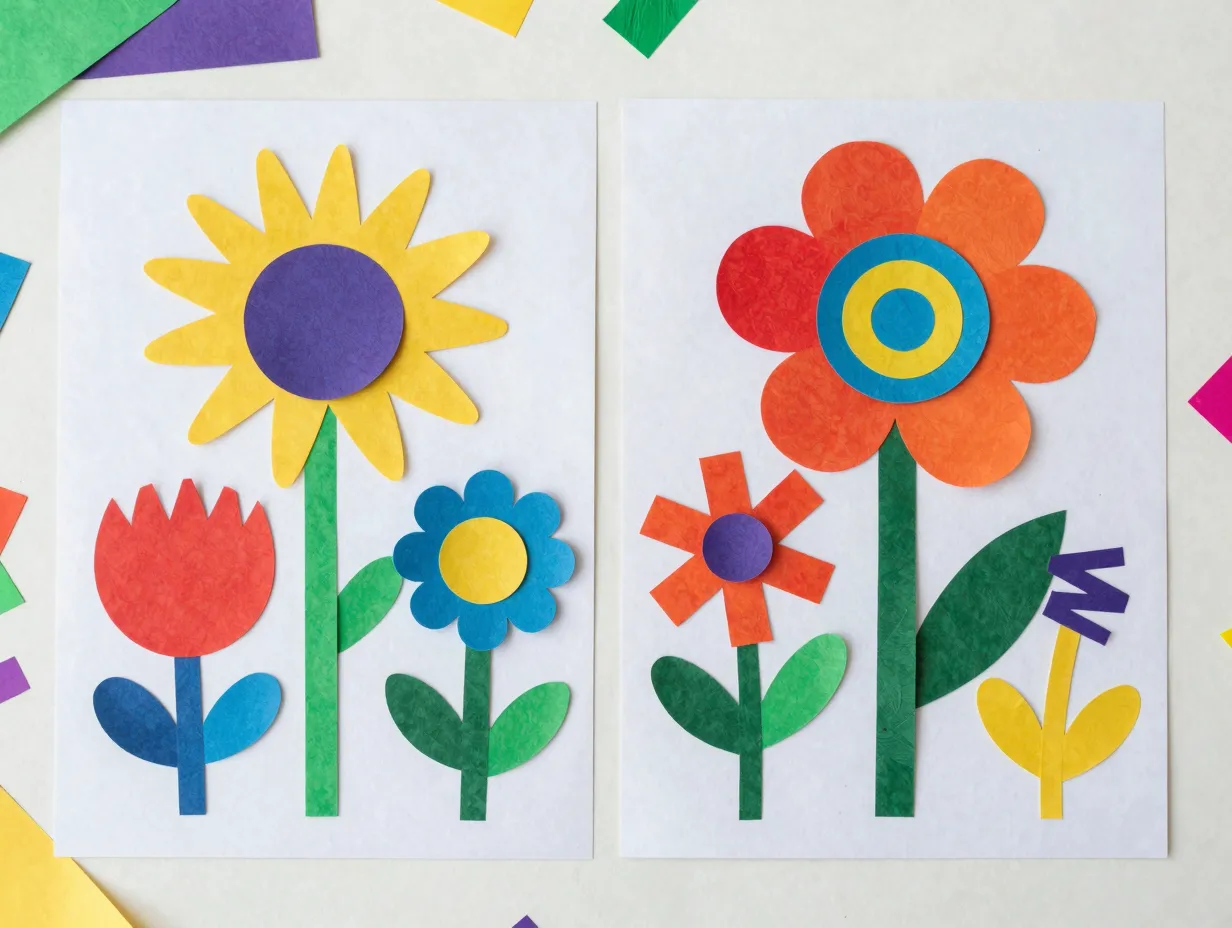
Unlike the more structured projects on this list, whimsical paper flowers are intentionally open-ended. Children cut and assemble any shapes they like from colorful construction paper, layering them to create flowers that reflect their own imagination [4].
Steps at a glance:
- Offer children several colors of construction paper and scissors.
- Encourage them to cut any shapes they want: circles, spirals, zigzags, fringed strips.
- Layer and glue the shapes on top of one another to build a flower.
- Add a stem and leaves cut from green paper.
- Display or combine multiple flowers into a garden scene.
The lack of a rigid template is the point. In my experience, this project produces the most personal and varied results of any on this list, and children are often more proud of their whimsical flowers than of more technically precise projects [4].
5. Geometric Shape Flowers
Best age: 5 to 8
Time: 20 to 25 minutes
Primary benefit: Geometry recognition, math-art integration
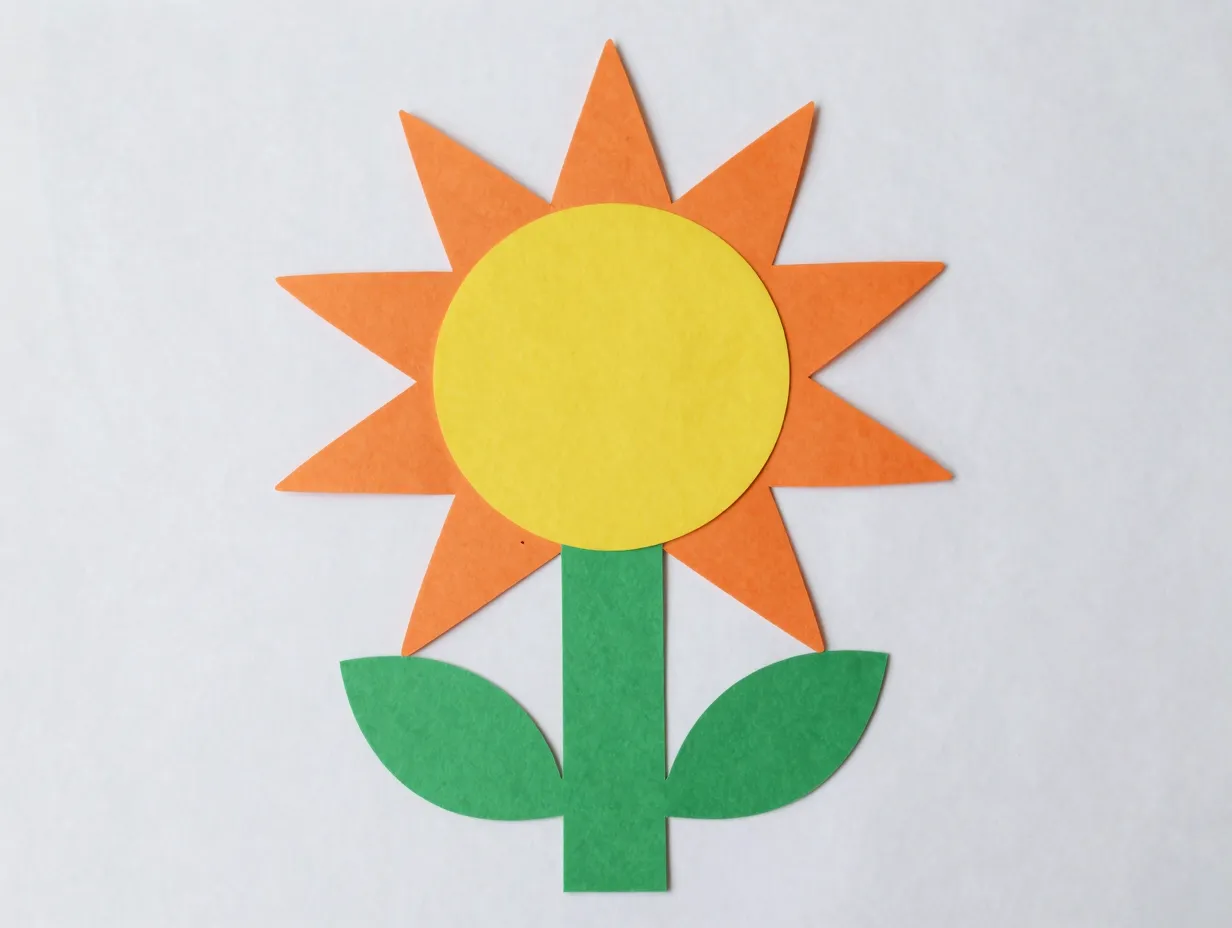
This project takes a deliberate educational approach. Children cut specific geometric shapes, such as squares, rectangles, triangles, and hexagons, and assemble them into flower designs [5]. The activity teaches shape recognition in a hands-on, visual way that is far more engaging than a worksheet.
Steps at a glance:
- Pre-cut or have children cut a variety of geometric shapes from different colors.
- Use a large circle as the flower center.
- Arrange triangles or rectangles around the center as petals.
- Glue everything onto a background sheet of paper.
- Add a rectangular stem and leaf shapes cut from green paper.
A simple reference table for shape-to-flower-part mapping:
| Shape | Flower Part |
|---|---|
| Large circle | Flower center |
| Triangles | Pointed petals |
| Rectangles | Stem |
| Ovals | Rounded petals |
| Leaf shapes | Leaves |
This project works beautifully as a classroom activity because it connects directly to geometry curriculum standards [5].
6. Torn Paper Petal Flowers
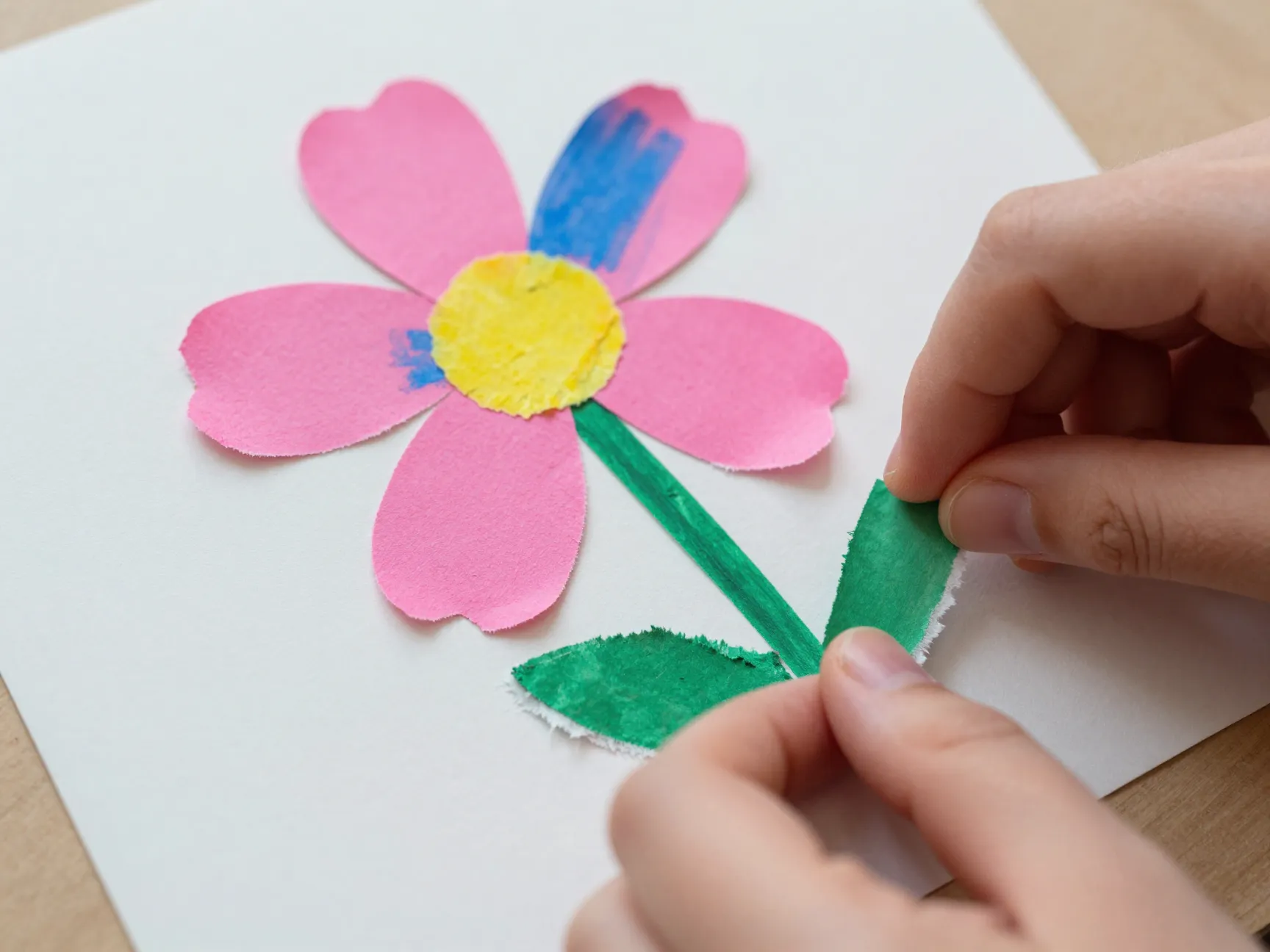
Best age: 3 to 6
Time: 15 to 25 minutes
Primary benefit: Sensory development, fine motor strength
This is the most accessible project on the entire list, and it is ideal for toddlers and preschoolers. Instead of cutting, children tear construction paper into small pieces and arrange them to form flower shapes [6]. The tearing motion itself is a significant fine motor exercise that strengthens the pincer grip.
Steps at a glance:
- Provide children with several colors of construction paper.
- Ask them to tear the paper into small pieces, roughly petal-sized.
- Draw a simple flower outline on a background sheet of white paper.
- Have children fill in the petals and center with torn pieces, gluing as they go.
- Add a torn green strip for the stem.
I have used this project with children as young as two and a half, with an adult guiding the gluing. The sensory satisfaction of tearing paper is genuinely calming for many children, and the finished flower looks surprisingly polished [6].
7. Fraction Flowers
Best age: 7 to 10
Time: 30 to 40 minutes
Primary benefit: Fraction concepts, math-art integration
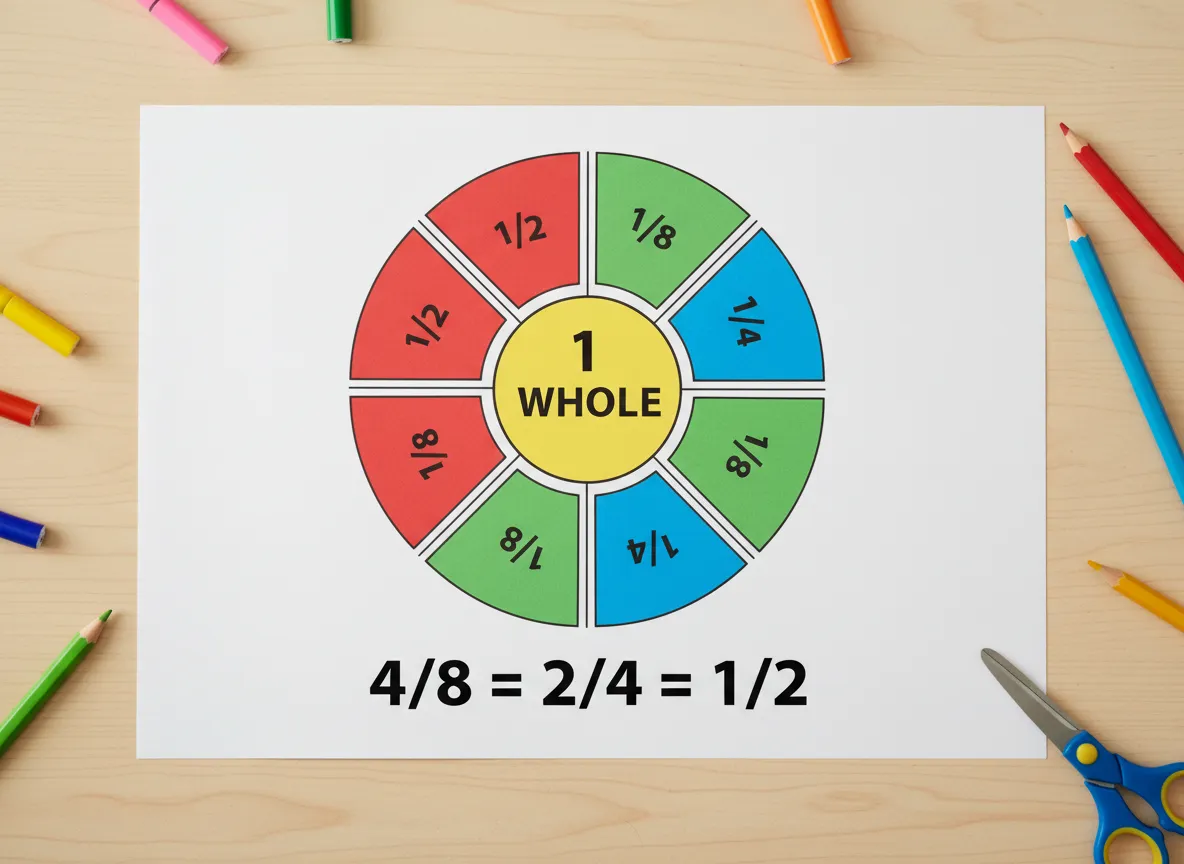
This is one of the most clever educational crafts I have ever encountered. Children create flowers using circles divided into equal parts, with each section representing a fraction [7]. A flower might have petals made from halves, quarters, and eighths, all color-coded to make the relationships visually clear.
Steps at a glance:
- Cut circles of the same size from several colors of construction paper.
- Fold and cut one circle in half, another into quarters, another into eighths.
- Arrange the pieces as petals around a central circle, labeling each with its fraction value.
- Glue everything onto a background sheet.
- Discuss with the child how many eighths equal one half, and so on.
The visual nature of this craft makes abstract fraction concepts concrete. A child who has built a fraction flower genuinely understands that four quarters make a whole in a way that a textbook diagram rarely achieves [7].
Key fraction relationships to reinforce:
- 1/2 = 2/4 = 4/8
- 1/4 = 2/8
- Two halves make one whole circle
8. Garden Suncatcher Flowers
Best age: 5 and up
Time: 30 to 45 minutes
Primary benefit: Science connection, observation skills, light and color
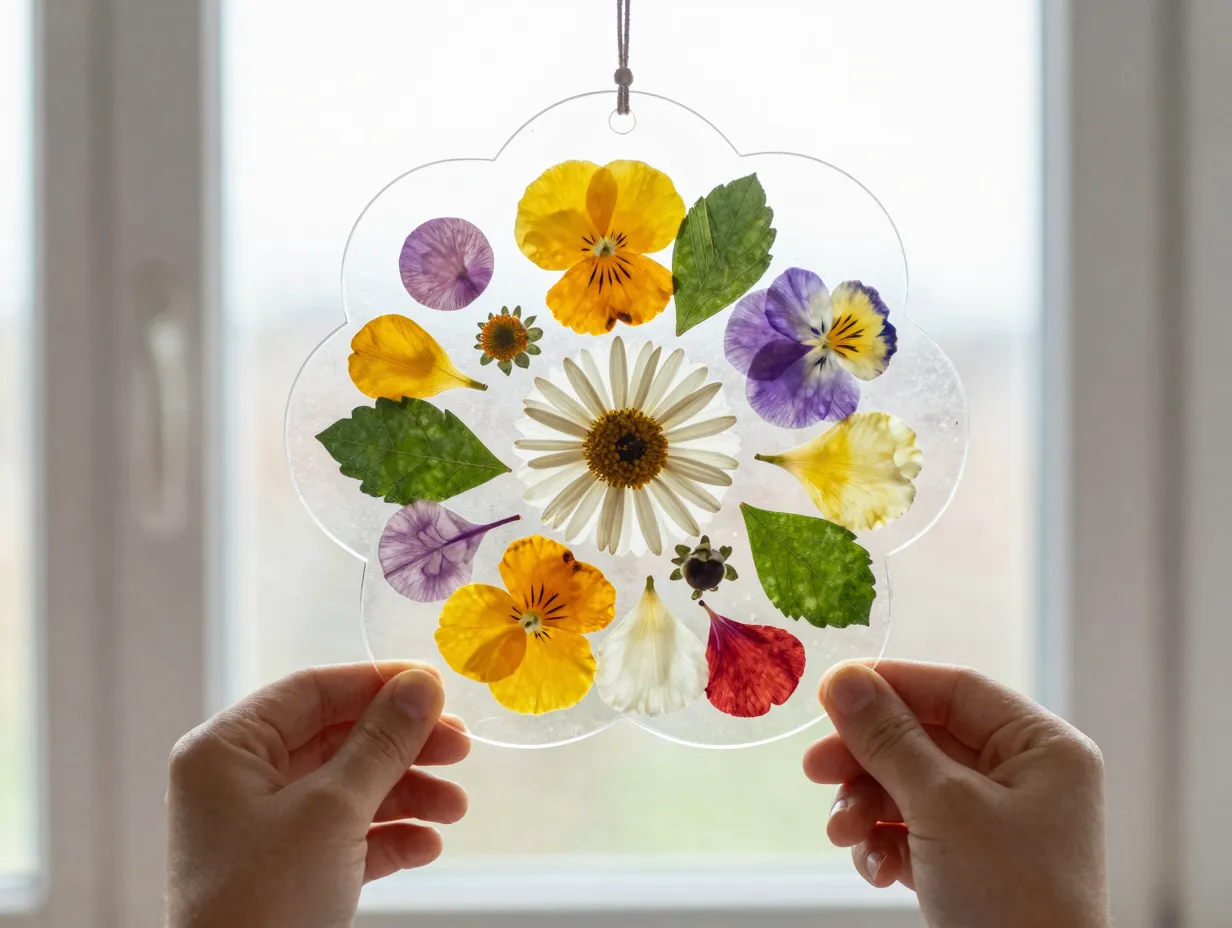
This project bridges paper crafting with a nature science lesson. Children press real or dried flowers alongside construction paper cutouts onto clear contact paper to create suncatchers [8]. When hung in a window, the finished piece glows with color and light.
Steps at a glance:
- Cut a piece of clear contact paper and peel off the backing.
- Lay it sticky-side up on a flat surface.
- Arrange pressed flowers, leaves, and construction paper shapes on the sticky surface.
- Press a second piece of contact paper on top to seal.
- Trim the edges and punch a hole at the top for hanging.
This project is particularly effective in spring when fresh flowers are available. I recommend pairing it with a brief discussion about how light passes through translucent materials, connecting the craft to basic optics in a way children can see and touch [8].
9. Tissue Paper Stained-Glass Suncatcher Flowers
Best age: 6 and up
Time: 30 to 40 minutes
Primary benefit: Color theory, light exploration, fine motor precision
The final project on this list of 9 vibrant construction paper flowers kids can make is technically the most striking in terms of visual impact. Children cut a flower outline from black cardstock, then fill in the petals with small pieces of colored tissue paper [2]. When held up to a window, the result mimics the look of a stained-glass window.
Steps at a glance:
- Draw a large, bold flower outline on black cardstock.
- Carefully cut out the interior of each petal, leaving the black outline intact.
- Cut small squares of colored tissue paper.
- Glue the tissue paper squares over the cut-out areas from behind.
- Trim any excess tissue paper from the edges.
- Hang in a sunny window to see the full stained-glass effect.
The contrast between the bold black outline and the translucent tissue paper is visually dramatic, and children are almost always surprised by how professional the finished piece looks. This is an excellent project for older kids who want a greater challenge [2].
How to Choose the Right Project for Your Child
Not every project on this list suits every child or situation. Use the guide below to match the right craft to the right moment.
| Situation | Best Project |
|---|---|
| Very young child (under 5) | Torn Paper Petal Flowers (6) |
| Quick gift for a parent | Mother’s Day Bouquet (1) |
| Classroom math lesson | Fraction Flowers (7) or Shape Flowers (5) |
| Rainy day with older kids | Origami Tulips (3) or Suncatcher (9) |
| Open creative session | Whimsical Shape Flowers (4) |
| Science lesson tie-in | Garden Suncatcher (8) |
| Child who loves 3D projects | 3D Looped Blooms (2) |
Tips for a Smooth Crafting Session
Prepare materials in advance. Pre-cutting shapes for younger children reduces frustration and keeps the session moving.
Embrace imperfection. A slightly lopsided petal is not a mistake. It is evidence of a child’s individual hand at work. Resist the urge to correct unless the child asks for help.
Work in batches. Making three or four flowers of the same type before moving on to a new design helps children build confidence and speed.
Display the finished work. Hanging completed flowers on a wall or window validates the child’s effort and encourages them to attempt more complex projects next time.
The Developmental Science Behind Paper Flower Crafts
It is worth pausing to acknowledge why these specific activities matter beyond the fun factor. Cutting with scissors requires bilateral coordination, the ability of both hands to work together in a controlled way. Gluing requires pressure calibration and spatial judgment. Folding, as in origami, activates the same neural pathways used in geometry and three-dimensional thinking.
A growing body of research in early childhood education supports the integration of art and craft into academic learning. When children make fraction flowers, they are not just doing art. They are encoding mathematical relationships through physical manipulation, which is one of the most durable forms of learning available to the developing brain.
The 9 vibrant construction paper flowers kids can make in this guide were selected specifically because each one targets a distinct developmental domain. Together, they cover fine motor skills, spatial reasoning, mathematical thinking, sensory development, scientific observation, and creative expression.
Conclusion
The nine projects covered in this guide represent a full spectrum of difficulty, developmental benefit, and creative possibility. Whether you are a parent looking for a 20-minute weekend activity, a teacher planning a math-integrated art lesson, or a caregiver working on fine motor skills with a young child, at least two or three of these projects belong in your regular rotation.
Here are your actionable next steps:
- Start with the easiest project that matches your child’s age, either the Torn Paper Petal Flowers for toddlers or the Mother’s Day Bouquet for preschoolers.
- Gather the basic supply list outlined earlier in this article. Most items cost under five dollars total.
- Try one project per week over nine weeks. By the end, your child will have a portfolio of nine distinct paper flowers and a noticeably improved set of craft skills.
- Photograph each finished flower and create a simple scrapbook or digital album. Reviewing their progress over time is a powerful confidence builder for children.
- Use the educational projects, particularly the Fraction Flowers and Shape Flowers, as supplements during homework time to reinforce what children are learning in school.
The beauty of the 9 vibrant construction paper flowers kids can make is that they require almost nothing in terms of cost or preparation but return an enormous amount in terms of skill development, creative confidence, and the simple joy of making something with your hands. Start today with whatever paper you have on hand. The first flower is always the hardest. After that, they bloom quickly.
References
[1] Mothers Day Paper Flower Bouquet – https://kidsactivitiesblog.com/82779/mothers-day-paper-flower-bouquet/?utm_source=openai
[2] Blooming Fun Easy Flower Crafts For Kids – https://www.imthecheftoo.com/blogs/stem-for-kids/blooming-fun-easy-flower-crafts-for-kids?utm_source=openai
[3] Easy Paper Flowers For Kids – https://torlykid.com/easy-paper-flowers-for-kids/?utm_source=openai
[4] Whimsical Paper Flower Craft – https://www.mynourishedhome.com/whimsical-paper-flower-craft/?utm_source=openai
[5] Shape Flower – https://www.allkidsnetwork.com/crafts/shapes/shape-flower?utm_source=openai
[6] Paper Petal Flower – https://www.chickasawkids.com/getattachment/4ff2683a-7e27-4892-8bfe-893df6143da8/Paper-Petal-Flower.aspx?utm_source=openai
[7] Fraction Flowers – https://primaryjunction.net/2011/10/fraction-flowers.html?utm_source=openai
[8] 06115db25a1f35d63800c0cc4574940b – https://www.learningmadefunwithmaestracasindo.com/_downloads/06115db25a1f35d63800c0cc4574940b?utm_source=openai